Ergonomic risk assessment of musculoskeletal discomfort of poultry workers in Nigeria
DOI:
https://doi.org/10.15675/gepros.3057Keywords:
Ergonomic asseement, Musculoskeletal disorders, Postural risk, Poultry workerAbstract
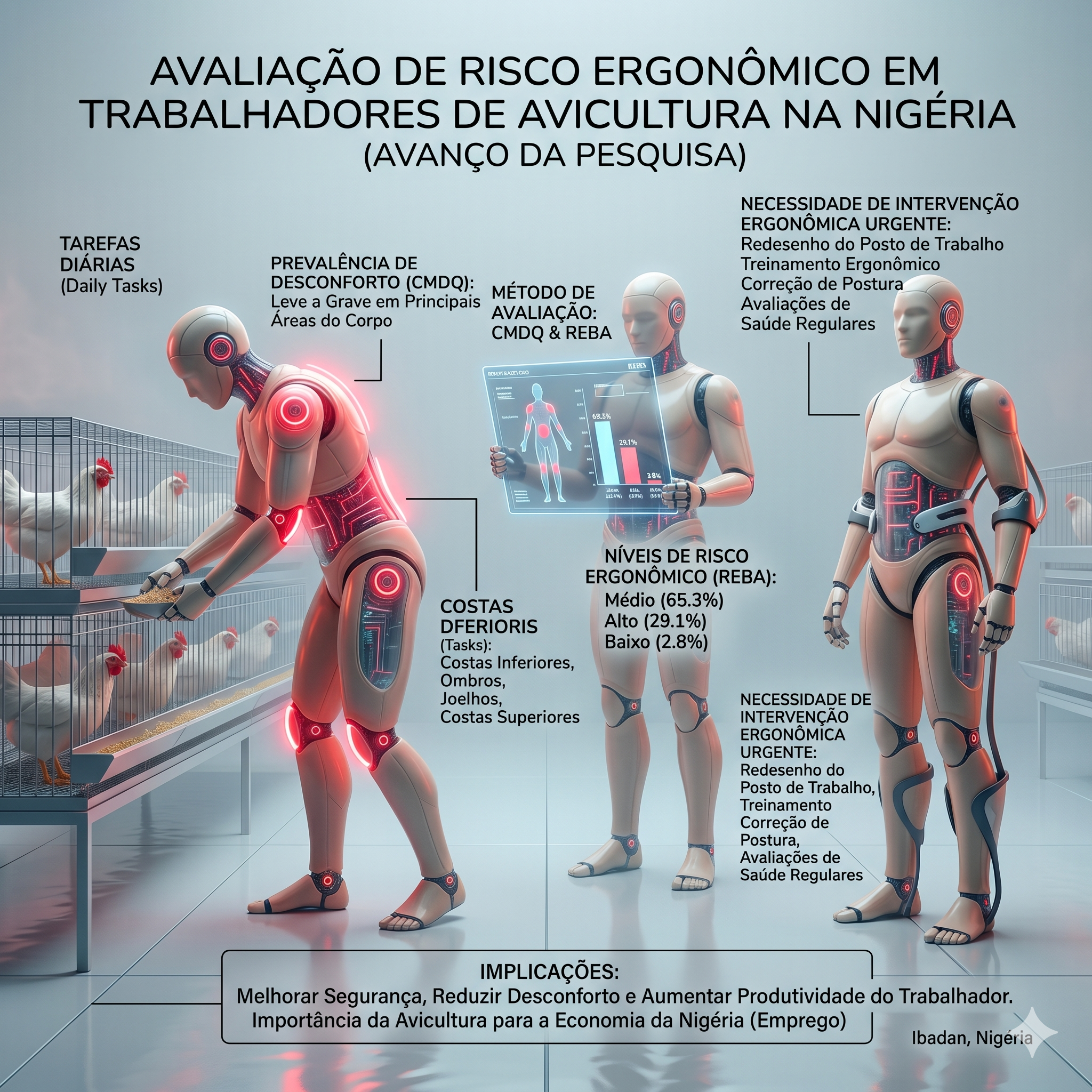
Purpose: Poultry farming is important to Nigeria’s economy in providing employment opportunities for many Nigerians. Studies on poultry workers' exposure to ergonomic risks causing musculoskeletal discomfort are sparse. The study aim to assess prevalence of ergonomic risk musculoskeletal discomfort among poultry workers using combined Cornell Musculoskeletal Discomfort Questionnaire (CMDQ) and Rapid Entire Body Assessment (REBA). Design/methodology/approach: A purposively selected seventy-two poultry workers in Ibadan, Nigeria, participated in this study. Socio-demographic data including gender, age, working hours, work experience, and daily tasks were collected. The CMDQ was used to determine discomfort levels in various body regions, while REBA was employed to evaluate the ergonomic risks associated with their working postures. Findings: It was revealed that poultry workers frequently experience discomfort in the lower back, shoulders, knees, and upper back, with varying severity levels. The CMDQ revealed that some workers reported mild to severe discomfort in key body areas, which may impact productivity and overall well-being of the workers. The REBA scores revealed that 65.3% of the workers faced medium ergonomic risk, 29.1% faced high risk, 2.8% faced low risk, and 2.8% faced very high risk, necessitating various categories of interventions. Research, practical & social implications: There is need for urgent ergonomic intervention in poultry farming operations studied. This may require workstation redesign, ergonomic training, posture correction, and regular health assessments to reduce ergonomics risk. These measures if implemented will enhance worker safety, reduce musculoskeletal discomfort, and improve overall productivity of poultry workers.
References
Agarwaal, A., Nair, S. K., Kartik, C. V., Pardeshi, A., & Sarawade, S. (2016). Ergonomic evaluation to improve work posture. International Journal of Engineering Research, 5(3), 1–5. DOI: https://doi.org/10.17577/IJERTV5IS031136
Ali, N. A. M., Alias, A. N., Noor, M. A. M., & Yaakub, N. (2025). Assessment of ergonomic risk factor and musculoskeletal discomfort among construction workers in Terengganu. Journal of Advanced Research in Business and Management Studies, 39(1), 61–69. https://doi.org/10.37934/arbms.39.1.6169 DOI: https://doi.org/10.37934/arbms.39.1.6169
Anwar, A., Khan, M., Saeed, K., Batool, S. A., Ibrar, I., Maqsood, S., & Anwar, U. (2022). Association between body posture and incidence of work-related musculoskeletal disorders (MSDS). Pakistan Journal of Medical & Health Sciences, 16(5), 911. DOI: https://doi.org/10.53350/pjmhs22165911
Aziz, F. A., & Hafidz, N. A. A. (2024). The prevalence of musculoskeletal disorders symptoms and ergonomics risk amongst engineering, science, and technology students. In Intelligent Manufacturing and Mechatronics, iM3F 2023 (pp. 377–387). Springer. https://doi.org/10.1007/978-981-99-8819-8_30 DOI: https://doi.org/10.1007/978-981-99-8819-8_30
Balogh, D., Cui, X., Mayer, M., Koehncke, N., Dueck, R., & Lang, A. E. (2025). Reliability and agreement during rapid entire body assessment: comparing rater expertise and artificial intelligence. PLOS ONE, 20(5), e0323262. https://doi.org/10.1371/journal.pone.0323262 DOI: https://doi.org/10.1371/journal.pone.0323262
Battini, D., Faccio, M., Persona, A., & Sgarbossa, F. (2011). New methodological framework to improve productivity and ergonomics in assembly system design. International Journal of Industrial Ergonomics, 41(1), 30–42. https://doi.org/10.1016/j.ergon.2010.12.001 DOI: https://doi.org/10.1016/j.ergon.2010.12.001
Cankaya, O., Oguz-Gokcen, S., & Koyunoglu, T. (2025). Musculoskeletal pain and discomfort in final-year physiotherapy and rehabilitation students: a cross-sectional study. Archives of Health Science and Research, 12(1), 1–7. https://archhealthscires.org/index.php/pub/article/view/596/596 DOI: https://doi.org/10.5152/ArcHealthSciRes.2025.24192
Chen, J., Qiu, J., & Ahn, C. (2017). Construction worker’s awkward posture recognition through supervised motion tensor decomposition. Automation in Construction, 77, 67–81. https://doi.org/10.1016/j.autcon.2017.01.020 DOI: https://doi.org/10.1016/j.autcon.2017.01.020
Choi, H.-W., Kim, Y.-K., Kang, D.-M., Kim, J.-E., & Jang, B.-Y. (2017). Characteristics of occupational musculoskeletal disorders of five sectors in service industry between 2004 and 2013. Annals of Occupational and Environmental Medicine, 29(1), 1–9. https://doi.org/10.1186/s40557-017-0198-4 DOI: https://doi.org/10.1186/s40557-017-0198-4
Davis, K. G., & Kotowski, S. E. (2007). Understanding the ergonomic risk for musculoskeletal disorders in the United States agricultural sector. American Journal of Industrial Medicine, 50(7), 501–511. https://doi.org/10.1002/ajim.20479 DOI: https://doi.org/10.1002/ajim.20479
Haekal, J., Hanum, B., & Prasetio, D. E. (2020). Analysis of operator body posture packaging using rapid entire body assessment (REBA) method: a case study of pharmaceutical company in Bogor, Indonesia. International Journal of Engineering Research and Advanced Technology, 6(7), 27–36. https://doi.org/10.31695/IJERAT.2020.3620 DOI: https://doi.org/10.31695/IJERAT.2020.3620
Hancharoenkul, B., Joseph, L., Khamwong, P., & Pirunsan, U. (2023). An investigation of the prevalence of work-related musculoskeletal pain and related disability among poultry slaughterhouse workers: a cross-sectional study. International Archives of Occupational and Environmental Health, 96(3), 463–472. https://doi.org/10.1007/s00420-022-01940-x DOI: https://doi.org/10.1007/s00420-022-01940-x
Hassani, M., Kabiesz, P., Hesampour, R., Ezbarami, S. M., & Bartnicka, J. (2022). Prevalence of musculoskeletal disorders, working conditions, and related risk factors in the meat processing industry: Comparative analysis of Iran-Poland. WORK: A Journal of Prevention, Assessment & Rehabilitation, 74(1), 309–325. https://doi.org/10.3233/WOR-211362 DOI: https://doi.org/10.3233/WOR-211362
Jahanimoghadam, F., Horri, A., Hasheminejad, N., Nejad, N. H., & Baneshi, M. R. (2018). Ergonomic evaluation of dental professionals as determined by rapid entire body assessment method in 2014. Journal of Dentistry (Shiraz), 19(2), 155–158. https://pmc.ncbi.nlm.nih.gov/articles/PMC5960736/
Kaka, B., Idowu, O. A., Fawole, H. O., Adeniyi, A. F., Ogwumike, O. O., & Toryila, M. T. (2016). An analysis of work-related musculoskeletal disorders among butchers in Kano Metropolis, Nigeria. Safety and Health at Work, 7(3), 218–224. https://doi.org/10.1016/j.shaw.2016.01.001 DOI: https://doi.org/10.1016/j.shaw.2016.01.001
Kee, D. (2021). Comparison of OWAS, RULA and REBA for assessing potential work-related musculoskeletal disorders. International Journal of Industrial Ergonomics, 83, 103140. https://doi.org/10.1016/j.ergon.2021.103140 DOI: https://doi.org/10.1016/j.ergon.2021.103140
Khan, M. I., Bath, B., Boden, C., Adebayo, O., & Trask, C. (2019). The association between awkward working posture and low back disorders in farmers: a systematic review. Journal of Agromedicine, 24(1), 74–89. https://doi.org/10.1080/1059924X.2018.1538918 DOI: https://doi.org/10.1080/1059924X.2018.1538918
Komeili, A., Rostami, M., Ansari, A. M., Khosravi, M., Sadeghiyan, M. P., & Sahlabadi, A. S. (2025). Investigating the prevalence of musculoskeletal disorder risks in an auto parts manufacturing industry in Tehran: Comparative evaluation of the CRAMUD, REBA, and CMDQ methods. Physical Treatment: Specific Physical Therapy Journal. https://doi.org/10.32598/ptj.2026.683.4 DOI: https://doi.org/10.32598/ptj.2026.683.4
Kumar, J., George, S. A., & Abraham, A. T. (2022). A review on use of rapid entire body assessment (REBA) tool to evaluate musculoskeletal disorder among health professionals. World Wide Journal of Multidisciplinary Research and Development, 8(8), 4–8.
Kusuma, T. Y. T. (2020). Analysis of body posture using rapid entire body assessment and rapid upper limb assessment to improve the posture of sand paper machine operators and reduce the risk of low back pain. Biology, Medicine, & Natural Product Chemistry, 9(1), 21–25. https://doi.org/10.14421/biomedich.2020.91.21-25 DOI: https://doi.org/10.14421/biomedich.2020.91.21-25
Li, Z., Zhang, R., Lee, C.-H., & Lee, Y.-C. (2020). An evaluation of posture recognition based on intelligent rapid entire body assessment system for determining musculoskeletal disorders. Sensors, 20(16), 4414. https://doi.org/10.3390/s20164414 DOI: https://doi.org/10.3390/s20164414
Magri, C. A., Garcia, R. G., Binotto, E., Burbarelli, M. F. C., Gandra, E. R. S., Przybulinski, B. B., Caldara, F. R., & Komiyama, C. M. (2021). Occupational risks and their implications for the health of poultry farmers. WORK, 70(3), 815–822. https://doi.org/10.3233/WOR-205179 DOI: https://doi.org/10.3233/WOR-205179
Meyers, J. R. (2001). Injuries among farm workers in the United States 1995. NIOSH.
Milania, A., Siregar, F., Arista, N., Al-karimah, N., & Prabaswari, A. (2021). Re-designed work station for breeding hens based on work posture and anthropometrics in Widodomartani. Journal of Physics: Conference Series, 1803, e012030. https://iopscience.iop.org/article/10.1088/1742-6596/1803/1/012030/pdf DOI: https://doi.org/10.1088/1742-6596/1803/1/012030
Muyiwa, O. A., & Akanbi, O. G. (2021). A mathematical model to determine safe weight lift among manual workers in Nigeria. GSJ, 9(11), 2139–2151.
Ng, A. (2022). Integrating physical load exposure calculations and recommendations in digitalized ergonomics assessment processes. In SPS2022: Proceedings of the 10th Swedish Production Symposium. IOS Press.
Olowogbon, T. S., Babatunde, R. O., Asiedu, E., & Yoder, A. M. (2021). Prevalence and exposure to ergonomic risk factors among crop farmers in Nigeria. Applied Sciences, 11(24), 11989. https://doi.org/10.3390/app112411989 DOI: https://doi.org/10.3390/app112411989
Rezvanizadeh, M., Mohammad-Ghasemi, M., Soltanzadeh, A., & Sadeghi-Yarandi, M. (2023). Development of a novel ergonomic index assessment in the workplace based on physical, cognitive, and environmental components. WORK, 75(1), 1–16. DOI: https://doi.org/10.3233/WOR-220335
Rizkya, I., Syahputri, K., Sari, R., & Siregar, I. (2018). Evaluation of work posture and quantification of fatigue by Rapid Entire Body Assessment (REBA). IOP Conference Series: Materials Science and Engineering, 309, 012051. https://doi.org/10.1088/1757-899X/309/1/012051 DOI: https://doi.org/10.1088/1757-899X/309/1/012051
Sarkar, K., Dev, S., Das, T., Chakrabarty, S., & Gangopadhyay, S. (2016). Examination of postures and frequency of musculoskeletal disorders among manual workers in Calcutta, India. International Journal of Occupational and Environmental Health, 22(2), 151–158. https://doi.org/10.1080/10773525.2016.1189682 DOI: https://doi.org/10.1080/10773525.2016.1189682
Sathe, S., Baxi, M., Chaudhary, N., Pawar, V., & Bhirange, S. (2021). Ergonomic evaluation of street vendors as determined by rapid entire body assessment method. International Journal of Current Research and Review, 13(8), 62–66. https://doi.org/10.31782/IJCRR.2021.13819 DOI: https://doi.org/10.31782/IJCRR.2021.13819
Schwartz, A. H., Albin, T. J., & Gerberich, S. G. (2019). Intra-rater and inter-rater reliability of the rapid entire body assessment (REBA) tool. International Journal of Industrial Ergonomics, 71, 111–116. https://doi.org/10.1016/j.ergon.2019.02.010 DOI: https://doi.org/10.1016/j.ergon.2019.02.010
Speck, G. M., Guertler, C., Schvambach, M. I., Woodroffe, R. E., Virissimo, T., Damasceno, L. G. A., Seiffert, W. Q., Diaz Merino, G. S. A., & Diaz Merino, E. A. (2016). Ergonomic analysis of work in poultry. International Symposium on Work in Agriculture, Maringá, PR, Brazil.
Tee, K. S., Low, E., Saim, H., Zakaria, W. N. W., Khialdin, S. B. M., Isa, H., Awad, M., & Soon, C. F. (2017). A study on the ergonomic assessment in the workplace. AIP Conference Proceedings, 1883, 020034. https://doi.org/10.1063/1.5002052 DOI: https://doi.org/10.1063/1.5002052
Wang, H., Kong, Y. K., & Jung, M. C. (2012). Postural evaluation in a poultry farm for broiler chickens. International Journal of Occupational Safety and Ergonomics, 18(1), 67–75. https://doi.org/10.1080/10803548.2012.11076915 DOI: https://doi.org/10.1080/10803548.2012.11076915
Yazdanirad, S., Pourtaghi, G., Raei, M., & Mohammad, M. R. (2022). Development of modified rapid entire body assessment (MOREBA) method for predicting the risk of musculoskeletal disorders in the workplaces. BMC Musculoskeletal Disorders, 23, 82. https://doi.org/10.1186/s12891-022-05011-7 DOI: https://doi.org/10.1186/s12891-022-05011-7
Yoon, S. Y., Ko, J., & Jung, M. C. (2016). A model for developing job rotation schedules that eliminate sequential high workloads and minimize between-worker variability in cumulative daily workloads: Application to automotive assembly lines. Applied Ergonomics, 55, 8–15. https://doi.org/10.1016/j.apergo.2016.01.011 DOI: https://doi.org/10.1016/j.apergo.2016.01.011
Downloads
Published
How to Cite
Issue
Section
License
Copyright (c) 2026 Omotunde Alabi Muyiwa, Oluseye Adewale Adebimpe, Oluwatobiloba Isaac Okeegbe

This work is licensed under a Creative Commons Attribution 4.0 International License.
O(s) autor(es) do artigo autorizam a publicação do texto na revista e garantem que a contribuição é original e inédita, não estando em processo de avaliação em outra(s) revista(s). As opiniões, ideias e conceitos emitidos nos textos são de inteira responsabilidade do(s) autor(es), não sendo a revista responsável por tais conteúdos.
Os editores da revista reservam o direito de efetuar ajustes textuais e de adequação às normas da publicação, caso necessário.
Os autores mantêm os direitos autorais sobre o trabalho e concedem à revista o direito de primeira publicação, sendo o trabalho simultaneamente licenciado sob a Attribution 4.0 International (CC BY 4.0), o que permite o compartilhamento do trabalho com reconhecimento da autoria e publicação inicial nesta revista.
Os autores têm autorização para firmar contratos adicionais, separadamente, para distribuição não-exclusiva da versão do trabalho publicada nesta revista (ex.: publicar em repositório institucional ou como capítulo de livro), com reconhecimento de autoria e publicação inicial nesta revista.